
Tendo Marketplace and Your Revenue Cycle
The healthcare revenue cycle refers to the process of managing a patient’s journey through a medical episode, from scheduling/registration to final payment. Tendo Marketplace simplifies this process by collecting and guaranteeing payment upfront, while seamlessly integrating with your existing revenue cycle workflows. This ensures that patients move smoothly through your processes without creating additional on-off processes for your team.
Tendo Marketplace can help reduce your provider overhead substantially by simplifying the process.
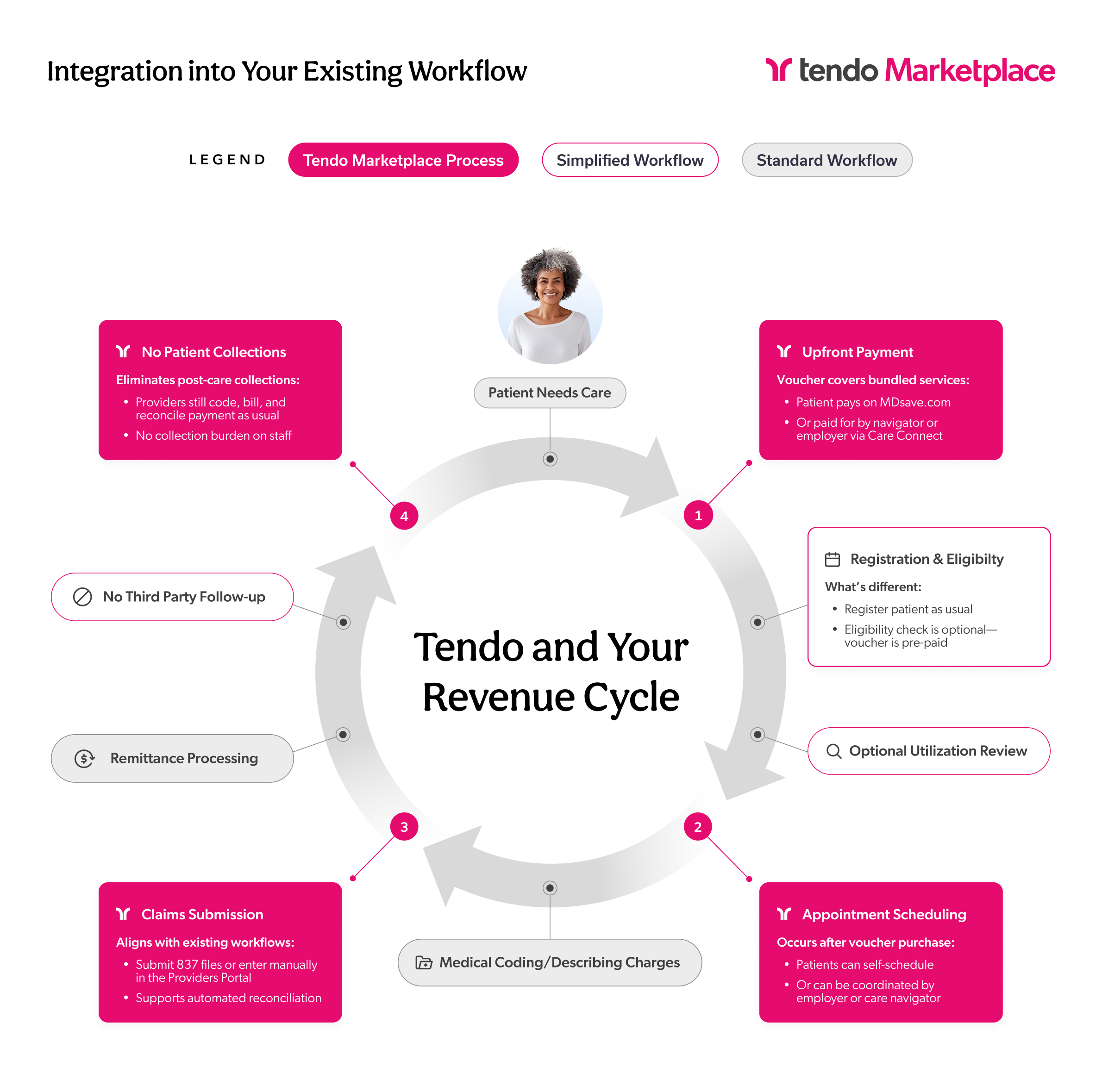
While the above steps are typically completed for most patients, the exact order and time can vary based on the practice or the type of care provided. For example, a walk-in clinic may conduct the first five steps when the patient walks through the door, but a surgery center may conduct them over several weeks.
Front-end Steps
Front-end steps happen before the patient receives care.
1. Scheduling Appointments
| Staff Members | Scheduler, Surgery Scheduler |
|---|---|
| Tools Used | EHR, Self-scheduling |
| Where it Happens | Typically over the phone or online |
MDsave patients purchase vouchers for their procedures in three ways:
- Directly on the mdsave.com website
- By working with care navigators for a company or organization that uses Care Connect, an employer service on Tendo Marketplace, as part of their employer healthcare plan. In the latter case, a care navigator can either contact you to schedule patient appointments or the Care Connect patient can schedule their appointment directly.
- By working with provider staff who help them purchase vouchers for procedures while scheduling their appointment.
The scheduler may use screening questions to determine what length of appointment to schedule and how urgent it is. New patient visits tend to be longer, and critical needs may require an immediate appointment. For some services, patients may need a referral to receive care.
For Tendo Marketplace patients, scheduling is still required and can happen after the purchase of a procedure unless the provider uses Tendo Marketplace to collect cash. Employer care coordinators may help schedule on behalf of the patient.
2. Pre-registration and Registration
| Staff Members | Patient Coordinator, Hospital Registrar |
|---|---|
| Tools Used | EHR, Self-report forms |
| Where it Happens | Typically over the phone or online, with in-person follow-up |
After or in combination with scheduling, the hospital staff needs to collect up-to-date information on the patient’s demographics and ensure they are correctly entered into their record. This includes the patient’s name, address, insurance information, guarantor information (if the person paying for the care is not the patient), etc.
Typically, the patient will complete pre-registration before visiting a provider, although it can also be completed or verified at the time of care. Pre-registration is the process of the patient providing their information, and registration refers to the use of that information to register them in the EHR and create a patient account.
At registration the patient's data (medical history, demographics, payment information, etc.) is compiled into a Face Sheet, which is designed to provide all necessary patient information at a quick glance. The registering facility also provides the Face Sheet to to other providers as needed.
For self-pay patients or those with a high deductible, pre-registration is a good time to tell patients that Tendo Marketplace may be a less expensive option to pay for a procedure.
3. Eligibility
| Staff Members | Insurance Verification Specialist |
|---|---|
| Tools Used | EHR, Estimators |
| Where it Happens | Conducted by hospital staff |
Once a patient’s information is provided, their eligibility for care will be verified. This involves checking with their insurance provider (if any) to make sure that they have valid coverage and that their plan will pay for the requested procedure. This can involve checking for doctor’s orders or requesting prior authorization from the insurance provider (via a 278 file). The insurance provider may give an authorization number that would be saved in the patient’s encounter record.
At this stage, the patient also is screened for eligibility for payment assistance, government programs such as Medicaid, or charity care. Some providers search various databases to discover insurance coverage for the patient that may not be on file.
For Tendo Marketplace patients, eligibility checks are not required since the procedure is pre-paid. However, if a patient has insurance, the provider may run an eligibility or prior-authorization check just in case they end up needing to bill the insurance plan.
4. Utilization Review
| Staff Members | Insurance Verification Specialist |
|---|---|
| Tools Used | EHR, insurer may have their own Utilization Management provider |
| Where it Happens | Conducted by hospital staff |
A provider reviews the patient case using clinical guidelines to determine if the care requested by the patient is medically necessary. For example, utilization review could determine that a patient should receive physical therapy instead of surgery. The provider or an insurer may conduct this review as part of the eligibility process.
For Tendo Marketplace patients, this step is not required but it may still be performed based on hospital policies.
5. Initial Payment
| Staff Members | Scheduler, Patient Coordinator, Registrar, Financial Counselor |
|---|---|
| Tools Used | EHR, 3rd party collection tools |
| Where it Happens | Online or at time of service |
Based on the patient’s circumstances, partial or full payment may be collected at the time of service — copays, estimated insurance costs, payment-in-full for cash pay patients, or enrollment in various payment plans.
If a patient is unable to pay easily, they may meet with a financial counselor who can help them understand options for covering the cost of their care, enrolling in government assistance programs, or enrolling in payment plans.
In an emergency room, a law called EMTALA prohibits providers from asking for any payment until a patient is stable.
For Tendo Marketplace patients, payment is collected as part of the voucher purchase. This can happen via an employer partner, online by the patient, or at the time of service or earlier through the provider. In the case of emergency room visits, Tendo Marketplace can only be offered after care is provided.
Care is Provided
The provider delivers care to the patient.
Back-end Steps
6. Describing Charges
| Staff Members | Provider, medical transcriber optionally (with EHR automation) |
|---|---|
| Tools Used | EHR |
| Where it Happens | Provider back-office or shared services center |
During/after the patient encounter, the provider (or medical transcriber) enters notes into the patient’s medical records.
After a patient encounter, the notes in the patient’s chart are converted into an itemized list of charges for the entire visit, which can include the length of stay, type of visit, procedures performed, etc. These different data points are used to determine the service level of a procedure. For example, a short visit by a health patient could be an “Office visit level 1”, but a long visit with a diabetic patient might be an “Office visit level 5”. Providers are paid different amounts for different procedure levels.
EHRs can do varying levels of automated charge capture based on the data entered into a patient’s medical records. This is also known as charge capture.
For Tendo Marketplace patients, this is not required but it typically still happens since the patient’s medical record is important for many other purposes. It also can be used to help validate that the patient purchased the correct voucher.
7. Medical Coding
| Staff Members | Medical Coder |
|---|---|
| Tools Used | EHR |
| Where it Happens | Provider back-office or shared services center |
A medical coder takes the notes and charges from the patient’s medical record and assigns diagnosis and procedure codes to each procedure. The diagnosis codes (ICD-10s) describe what condition the patient has (e.g., RO7.0 for “pain in throat”). And the procedure codes are a combination of DRG (Diagnosis-Related Group), Revenue Codes, and CPT® (Current Procedural Terminology) codes.
The coding process is intended to create standard definitions for the conditions of patients and the care they receive, so that insurance providers can more easily process claims. The codes are also used for analysis of patient medical data for individual patient review and larger studies by payers, providers, and researchers.
For Tendo Marketplace patients, this also happens, since the assigned codes are used for many reporting purposes. When a provider submits claims to Tendo, the codes are also utilized to generate the claim.
8. Submitting Claims
| Staff Members | Claims specialist, Medical biller |
|---|---|
| Tools Used | EHR, claims clearinghouse |
| Where it Happens | Provider back-office or shared services center |
Providers, or sometimes patients, submit the coded record data and associated charges to the insurance provider as a request for payment. Two or more claims are typically submitted per patient encounter. The facility will submit an institutional claim, and the providers will submit professional claims. Each type of claim goes through the same approval process.
Claims may be submitted electronically through a healthcare claims clearinghouse, via an 837 request. They may also be submitted on paper forms, often referred to as UB-04 (for institutional claims) and CMS-1500 (for professional claims).
This is not required for Tendo Marketplace, but providers have the option of submitting claims to Tendo instead of redeeming vouchers manually. This makes the Tendo Marketplace process more aligned with the typical patient process. It also allows Tendo Marketplace to generate a price adjustment to show the difference between the charged amount and the amount paid by Tendo Marketplace, which can support automated payment reconciliation.
9. Remittance Processing
| Staff Members | Claims specialist, Billing specialist, Payment Posting Team |
|---|---|
| Tools Used | EHR, claims clearinghouse |
| Where it Happens | Provider back-office or shared services center |
When an insurance provider processes a claim, they send an electronic 835 request or a paper EOB (explanation of benefits) form back to the provider. This includes the information about the claim status, whether it was approved or denied, and the amount paid. They also send payment to the provider via an ACH or check. For electronic payments, there are identifiers in the claim and in the ACH transfer that are used to link the payment to the associated claim.
For some providers, claims and payments are both sent directly to the provider’s banking institution, referred to as a lockbox account. This consists of both a physical PO Box and electronic connections, and the bank consolidates all payments and posts them directly into the medical providers EHR software.
Tendo Marketplace can pay providers directly with a PDF payment statement, which the provider would reconcile as a cash payment. But we also can send an electronic request such as an 835 file to the provider so that payment can be automatically applied to the patient account.
10. Third-party Follow-up
| Staff Members | Claims specialist, Billing specialist, Appeal specialist, Payment Compliance analyst |
|---|---|
| Tools Used | EHR, claims clearinghouse (Optum, Emdeon, Availity) |
| Where it Happens | Provider back-office or shared services center |
If an insurer denies or fails to pay a claim, the provider typically will follow up to dispute the decision, provide additional information, or seek other remediation. They may re-code and re-submit the claim based on the findings.
For example, if a doctor performs a different procedure than was scheduled, it would likely be denied by insurance. The provider would provide additional information to the insurance, such as what was changed and why, and request a retroactive authorization. If this was approved, they would submit the claim again.
For Tendo Marketplace patients, this process should not be necessary.
11. Patient Collections
| Staff Members | Collections |
|---|---|
| Tools Used | EHR, 3rd party tools (VisitPay, Cedar, etc.) |
| Where it Happens | Provider back-office or shared services center, Patient outreach, online |
Once a claim is resolved (or for uninsured patients, any additional financial responsibility falls to the patient. The providers will send bills to the patients through a variety of formats—email, paper bills, phone calls, etc. Patients may pay online, by mail, or in person at the provider.
If patients fail to pay their bills, providers may sell unpaid bills to collections agencies (e.g., the collection agencies pays $0.05 per $1 of debt). The provider writes off the remainder of the patient balance and the collections agency attempts to collect from the patient.
For Tendo Marketplace patients, this should not be necessary. If a patient does receive a bill from the facility or one of the third-party providers, they reach out to the Tendo support team for assistance in resolving the bill with the provider.
Scripting and Third-party Staffing
Scripting
At each step in the revenue cycle process, the Tendo Marketplace script to be followed by various staff members is encoded in their software tools. This can be a literal script, as in the actual words the staff member should say to the patient, as well as a set of data-based rules that the staff member should follow. For example, for an insured patient there may be a checklist of tasks such as validating that their insurance hasn’t changed, generating an estimate, etc.
Tendo Marketplace can include information about when and how to offer vouchers in the provider’s scripting. This ensures that the program is offered at the appropriate time to the appropriate patients.
Third-party Staffing
Often, all or part of the revenue cycle staff may be outsourced. This includes companies such as R1, TriZetto, Optum, and many others. Revenue cycle staff from these companies can work in person at the hospital and/or in back-office or remote locations. They often have control over scripting, and so need to be involved when recommending changes to the revenue cycle process.