
Procedure Bundles
IN THIS ARTICLE
How Tendo Uses Procedure Bundles to Simplify Healthcare
Historical Perspective on Bundles
How Tendo Uses Procedure Bundles to Simplify Healthcare
When you buy a consumer product from a cup of coffee to a car or computer, the price takes into account a complex supply chain that allocates payment to global suppliers, rent and store staff, delivery services, management overhead, advertising, and packaging. As the buyer, you never have to think about any of those services.
The exception is when you purchase healthcare. As a patient, you typically are billed separately for a care episode by each hospital, doctor, laboratory supplier, and technician involved in your care. In some cases, you’re billed for every aspirin, bandage, doctor’s check-in, or lab test, and aren’t told in advance the prices for these goods and services or how they contribute to your care. The result is a price that is sprung on you after the care and that can vary widely from patient to patient, insurance plan and network, and decisions made by different hospital billing departments.
This cumbersome payment system was long hidden from most Americans behind robust insurance coverage. When deductibles and copayments are low, patients rarely pay attention to the actual charges on medical bills they receive. However, with the increase in high deductible health plans (HDHPs), healthcare consumers are responsible for paying a larger portion of their healthcare costs out of their own pockets. Out-of-pocket expenses, which are increasing year by year, averaged $1,514 per capita in 2023, not including the amount that individuals contribute toward health insurance premiums.
At Tendo, we believe that patients deserve transparent, upfront price information for medical care, just like any other product or service they buy. This helps them make more informed decisions as well as benefitting providers and payers by eliminating some of the 25% of healthcare expense that goes towards billing and debt collection. Our Tendo Marketplace system uses procedure bundles with an upfront price that includes all of the providers who participate in a healthcare episode. This connects the existing fee-for-service billing system with a more consumer-friendly pricing model.
Tendo Marketplace processes thousands of these bundles every month, ranging from simple imaging procedures to surgeries like hip and knee replacements. Our national network of healthcare providers saves patients up to 60% over the price they otherwise would have paid for their care and increases cash collection rates at our partner hospitals by up to 30%.
Historical Perspective on Bundles
Our bundled payments are in some ways an attempt to return to an older, simpler model of healthcare payments that once existed in the United States, when patients typically paid their providers directly for the cost of care in a single bill. As Medicare and Medicaid were established in 1965 and the medical billing industry evolved, payment and coding became increasingly complicated until the result is today’s fee-for-service billing system. This system involves a number of steps:
- After a patient receives care, a medical record is completed and then coded using one of 70,000 ICD codes to describe the patient’s health condition and a set of 16,000 HCPCS or revenue codes describing the exact procedures that were executed.
- This coding is used to generate a bill that is either charged to the patient or sent to insurance, which approves, rejects, or re-prices the claim. This process is completed for each medical provider (hospital, physician, anesthesiologist, etc.), which can result in multiple bills and notices sent to the patient from their providers and insurance company.
- If the patient doesn't complete payment, their debt is passed on to a collections agency.
The system confuses patients and creates increased complexity and overhead, and additional codes are created and rules enacted every year. Third party payment vendors drive up costs, and the percentage of healthcare staff devoted to administration has increased from 18% in 1969 to more than 30% today.
In an attempt to simplify the process, a number of organizations have tried to build bundled payment methodologies, the largest of which is the Center for Medicare and Medicaid services (CMS), which administers government insurance plans. CMS pays hospital facilities a single rate for services based on the APC (Ambulatory Payment Classification, i.e. outpatient) or DRG (Diagnosis-Related Group, i.e. inpatient) code assigned to each case. However, these bundled payments apply only to the medical facility portion of each encounter. Physicians bill using the CPT® coding system and are paid based on global surgery package payment rules.
CMS attempts to provide bundled payment initiatives to facilities for an entire course of treatment have been problematic for hospital facilities because they are responsible for distributing payment to each participating provider, and some are not set up to process and manage payment distributions to physicians and other providers that work for them. Adding this results in additional costs.
A number of insurance providers also have worked on bundled payment fee schedules, which are retrospective based on a submitted claim after care. These don’t provide patients the price of a care episode in advance.
Neither of these bundling options are available to patients who are uninsured or those who choose to forego their insurance and pay out-of-pocket for healthcare. They don’t address the billing and price confusion that high deductible insurance plan consumers experience with typical everyday procedures like endoscopies, imaging, lab tests, and consultations.
Some integrated hospital groups and independent surgery centers that directly employ their doctors and support care staff create prospective bundles that allow patients to pay a known fixed cost upfront. However, most healthcare institutions in the United States are not integrated and find it difficult to execute bundles across multiple partners. They need a different kind of bundle.
It is important to note that there are bundling methodologies that typically focus on the components that should be included in bundles based on clinical best practices. They determine the set of services that are covered and the duration and type of services that are included in a warranty period after a procedure is performed. They are complementary to Tendo’s bundling approach.
Tendo’s Bundles
Tendo Marketplace offers upfront, transparent pricing to patients for the services of as wide a range of healthcare providers as possible.
Our procedure bundles are sold for a single price to the patient or another payer. Tendo negotiates the pricing for a procedure separately with each party involved in performing the services that are part of the bundle, such as a facility, surgeon, anesthesiologist, and pathologist. This payment can happen before or after the procedure is performed. After the procedure, we distribute payment to each participating party according to their pre-negotiated rate.
Although our bundles can be purchased either before or after care is provided, we have found that the largest benefit in cost reduction and simplification of the process for both patients and providers comes from purchasing prospective bundles.
The primary benefit to patients is that the bundles provide transparency and certainty about the cost of medical care. According to a University of Chicago poll, 40% of patients have delayed or skipped necessary care because they are unsure how much it will cost. Even more patients have had the negative experience of getting care but then receiving multiple unexpected bills after the fact. By paying in advance, patients are able to budget appropriately for their medical care and focus on recovery rather than bill management.
When a patient pays in advance, there is no bad debt or need for generating bills and tracking down missing payments. While coding of medical encounters can still be completed for clinical purposes, it is no longer required for generating a fee-for-service bill.
What about Complications?
The most common question that providers raise about prospective horizontal bundles is how to deal with complications. When care is paid for in advance, it is impossible to know exactly which variant of a procedure will be required or which complications may occur. The primary value of bundles is to average out the cost of care so that this knowledge isn’t necessary, but no bundle can cover all possible complications without increasing the cost prohibitively.
When additional services are required because of complications, additional procedures can be purchased after the fact. For example, if an ultrasound is necessary to follow up on a mammogram, or if a Cesarean section becomes necessary during delivery, the additional procedure can be purchased as a separate bundle. In higher risk bundles, complications outside the scope of the bundle can be passed on to insurance. This could involve using a traditional fee-for-service claim, or it could involve a per-bundle insurance policy that is included in the cost of the bundle. For example, BLIScare offers per-procedure insurance that covers complications arising from a range of surgical procedures.
Tendo’s system integrates with the existing fee-for-service coding system used by most medical providers. We composed each bundle using the HCPCS coding system and set a price based on the CMS fee schedule for the included HCPCS codes. This process involves considering the bundle’s participants, variants, and inclusions.
Bundle Width: Participants
Our buckets include the providers that account for the majority of the cost of a bundle, but providers who are rarely involved in the bundle are excluded to avoid increasing the bundle’s base price. Typically, the facility, physician, anesthesiologist, and pathologist (when relevant) are included in every surgical bundle. Excluded providers typically include cardiologists, radiologists, third party physician assistants, or third party labs. There are exceptions to this, such as radiologists who are included in diagnostic imaging bundles.
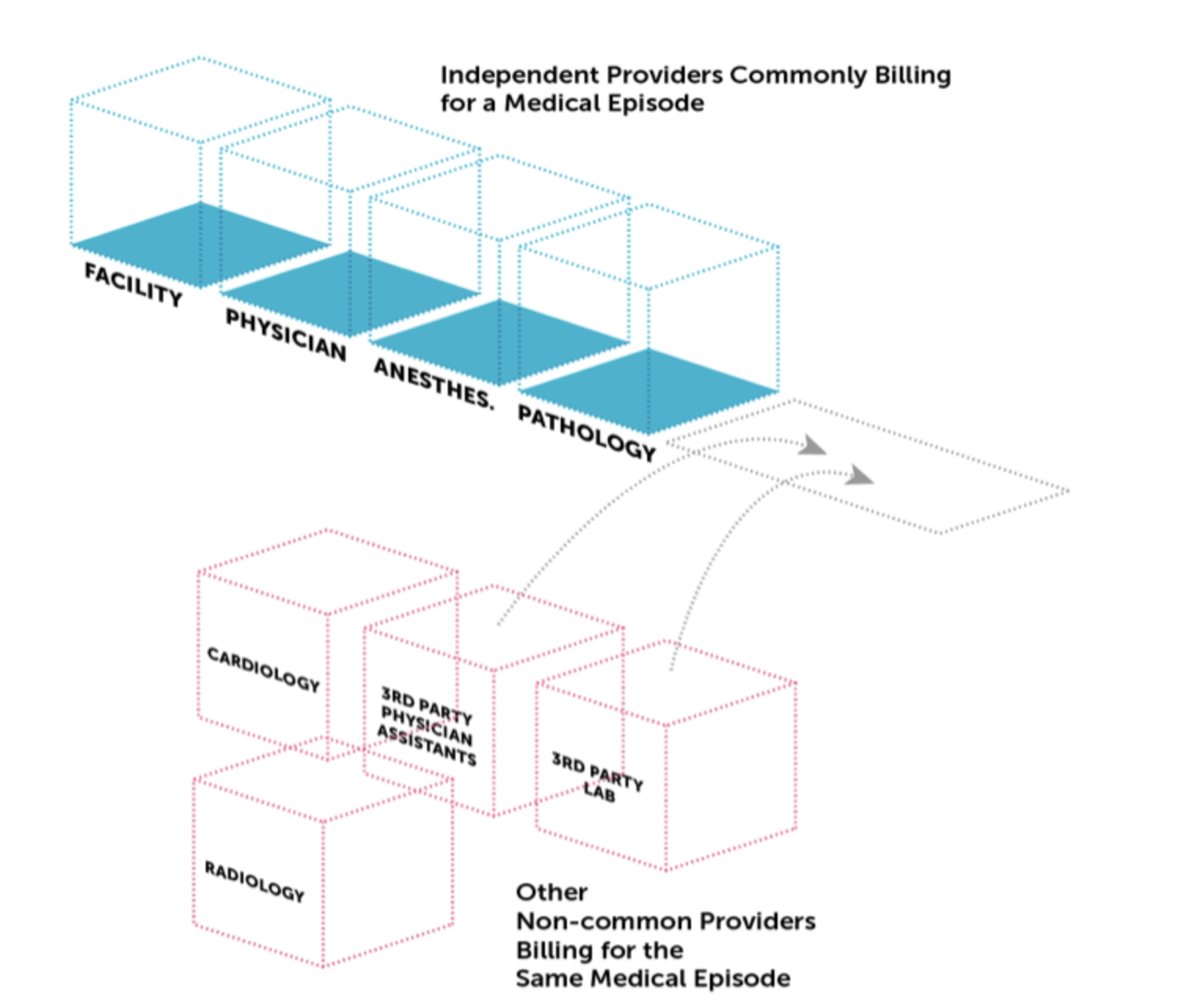
Horizontal bundles typically include the most common providers, including the facility, physician, anesthesia, and pathology fees. They can optionally include other providers, depending on the frequency with which those providers participate in the bundle.
Although the goal is always to make bundles include the full set of participants, it is important to clearly define for patients upfront what is included in the bundle they are purchasing and what additional bills they might receive. This avoids confusion when a patient does receive a third party bill, even if that is a rare occurrence. The same language also can help participating providers be more conscious about what is included in the bundle a patient has purchased, encouraging them to make use of the parties who are participating in the bundle whenever possible.
In practice, we have found that third party bills that “break” a bundle are relatively rare. When they do happen, patients are justifiably frustrated, so clear communication upfront is important in appropriately setting expectations.
Bundle Height: Variants
The second dimension of a bundle is variants of the primary procedure that are included in the bundle. In order to support bundles within the existing medical billing and coding system, we have created bundles that are associated with HCPCS codes for each procedure. However, a patient doesn't know in advance which exact variant of a procedure they will receive (e.g., a colonoscopy with biopsy, colonoscopy and polypectomy, colonoscopy with control of bleeding, etc.). These specific codes can be important for the purposes of a patient’s medical record, follow-up care, and aggregate analysis. For most procedures, the price differences among the possible procedure variants is small enough that simply averaging the price across the variants generates a reasonable value for each participating provider.
At Tendo, we use the CMS rate for each HCPCS code included in a bundle. The specific codes are selected according to the procedure bundle being performed, CMS price, and claims analysis. We then average the CMS rates, adjust for the local wage index, and apply a percentage above Medicare rates as agreed upon with each participating provider.
In some cases, the price variance between different procedure types is quite large (e.g., an MRI with or without contrast). These variants can simply be split into two different bundles. The exact choice of when to split bundles is determined by a provider’s preferred balance between simplicity of bundle selection and precision of pricing.
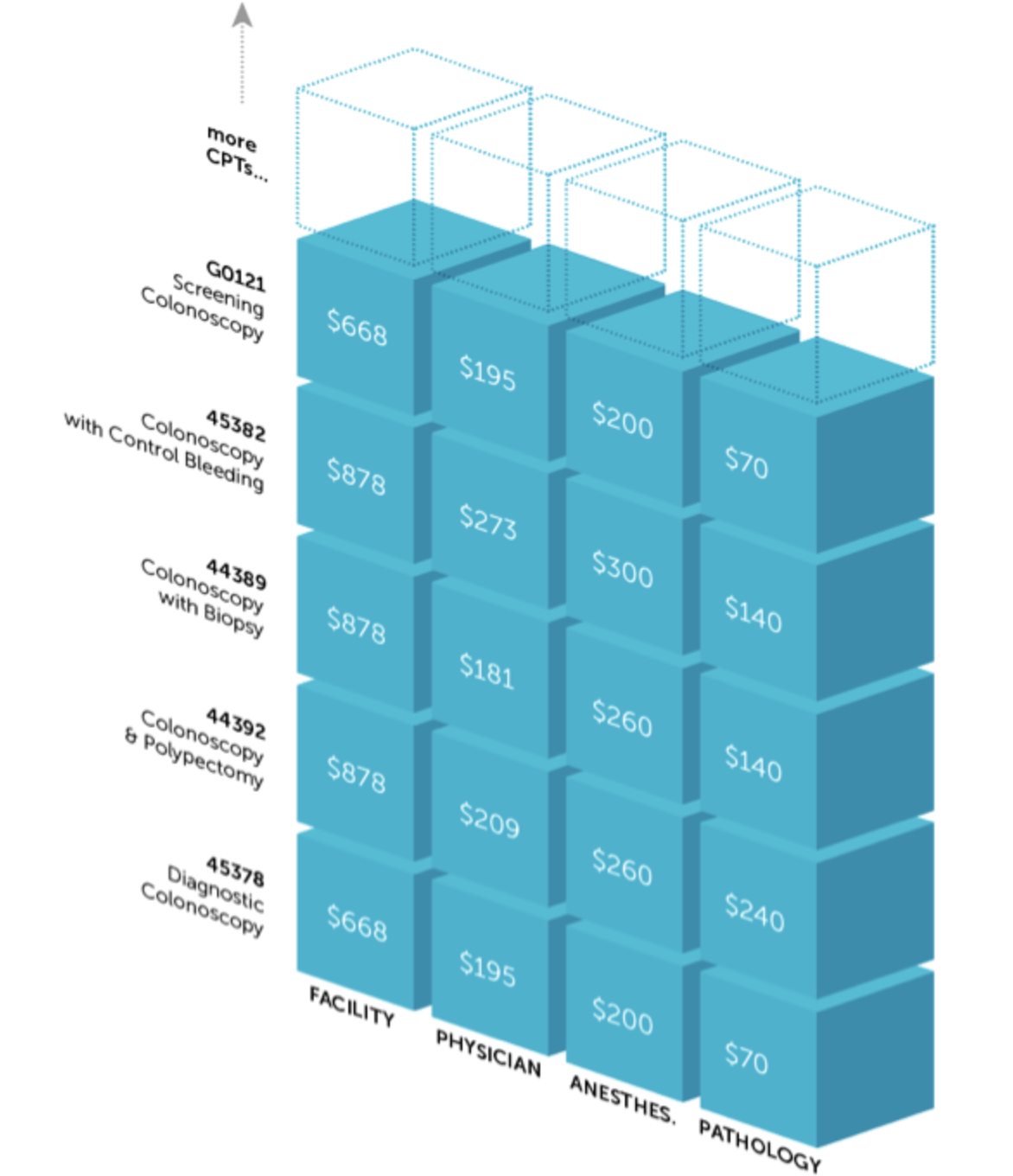
Bundles should include all of the possible variants of a procedure to act as a bridge between the code-based billing system and bundled payments.
Bundle Depth: Inclusions
The third dimension of a bundle is the care additional to the primary HCPCS codes that are included in the bundle. There can be a wide variance in the types of care included in each bundle, ranging from a single encounter to a broader course of treatment.
In a single encounter bundle, in addition to the facility, physician, and anesthesia fees, a small number of additional fees may be included. For example, imaging procedures typically include a pregnancy test.
Larger bundles can include many more elements. For example, a hip replacement bundle could include consultation sessions, preoperative lab work, follow-up exams, and physical therapy sessions, in addition to the surgery itself. For extended duration bundles, each “stage” of the bundle can be processed separately. This allows the bundle to be partially paid out and the balance refunded if, for example, a patient is determined to be a poor candidate for a surgery after undergoing preoperative testing.
Large bundles have advantages such as providing the patient with a clear picture of cost upfront for an entire course of treatment and formalizing the standard of care for a procedure in the structure of the bundle. However, they also are more complex to configure and contract. Many providers start with small, single encounter bundles. They then can begin to compose these encounters into larger episodes (e.g., a single “shopping cart” with diagnostic imaging, labs, and an outpatient surgery), which can lead to the creation of more inclusive episodes of care over time.
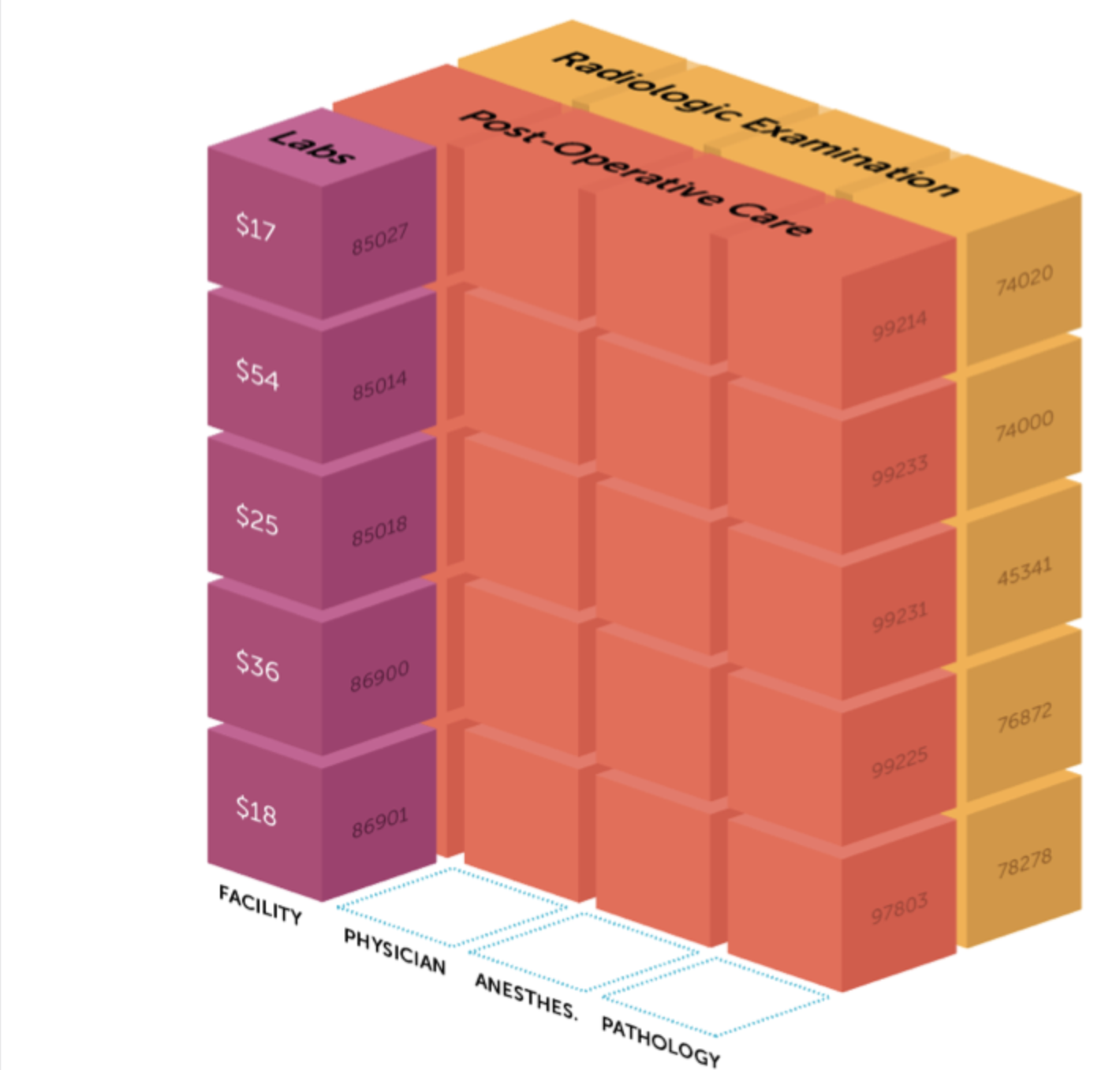
Bundles can have a wide range of inclusions, from a single episode to an extended course of care.
The Final Dimension: Consumerism
The final step in creating a horizontal bundle, after defining its participants, variants, and inclusions, is to package it in a form that can be understood by patient consumers and care navigators who shop for procedures for patients. Detailed orders and care plans are important to patients' care, but add needless complexity and confusion to the billing process. When these details are covered within a bundle, patients are presented with consumer-friendly terms that makes bills easier to understand and compare across different providers and services.
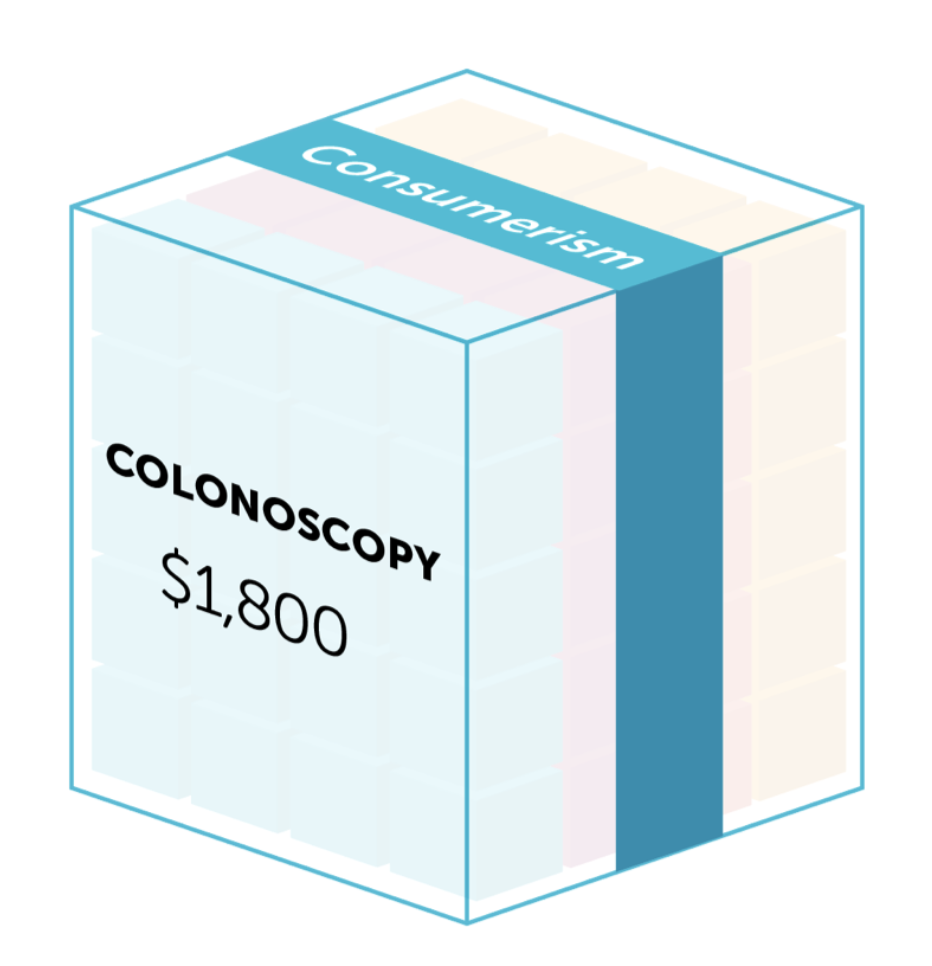
In order to be understood by consumers, bundles need to have simple names and a limited number of variations for the same type of procedure.
The balance between consumer-friendly and sufficiently nuanced bundles sometimes requires that a bundle is split into two variants in order to account for meaningful differences in care and cost. However, we have found the most benefit in keeping bundles as simple as possible. This simplification does not constrain the level of detail the provider requires to complete the clinical record, but it allows providers to focus on care rather than billing.
Tendo Marketplace’s Bundling Experience
Tendo Marketplace’s bundling system has been implemented at hundreds of hospitals for more than a decade. Tendo Marketplace operates on:
- The public mdsave.com healthcare marketplace, as a “cash register” allowing hospitals to provide fully bundled pricing directly to their patients.
- The Care Connect system for employers to provide healthcare for their employees. Care navigators for these companies help employees with finding and purchasing of bundled procedures through the Tendo Marketplace network as part of the companies' employee healthcare plans.
Tendo Marketplace serves thousands of patients per month, for procedures ranging from diagnostic imaging procedures to births, outpatient surgeries, knee and hip replacements, and bariatric surgeries. For each bundle, Tendo Marketplace contracts with each participating provider, collects payment from the patient, and distributes payment to each provider within six days from the time of service. This results in a positive experience for both patients and providers.
Patient Experience
Tendo Marketplace’s patient customers are extremely satisfied with the ability to purchase bundled healthcare, giving the service a Net Promoter Score of 91. (NPS is a standard measure of customer satisfaction, with a scale from -100 to 100. Health insurance companies receive an average score of 12.) These customers, who include customers who are uninsured, on a high-deductible insurance plan, or need care that their insurance plan has denied, use Tendo Marketplace to access affordable prices and for the convenience and certainty of paying for their medical procedures in advance. The all-inclusive prices provided by Tendo Marketplace allow many customers to receive care that they otherwise would have been unable to afford.
Employers who use our Care Connect service like it for the transparent and consistently priced procedure bundles.
Our insured customers often report that the bundled prices they find on the Tendo Marketplace are a better deal than the negotiated rates provided by their insurance plan or provides more certainty about their out-of-pocket costs. Many can use Tendo Marketplace to lower their spending before they reach their deductible and still file a claim with their insurance provider to count the expense towards their deductible. In this situation, a combination of a high deductible health plan, a health savings account (HSA), and Tendo Marketplace is an ideal set of tools to optimize healthcare expenses.
Patient Testimonials
Charlie, a paralegal from Georgia:
“My ENT said that I needed a MRI scan on my sinuses. My out of pocket costs were going to be over $1,200! I bought my procedure online and saved over $1,100.”
Johnny R, Tennessee:
“It was pretty simple, painless. I like simple. I think that’s what stops a lot of people from going - the not knowing. The not knowing the cost of what’s involved.”
Provider Experience
Tendo Marketplace also improves the collection rate for participating providers. Many healthcare providers collect only 16% of the total patient responsibility portion of their bills. By using Tendo Marketplace to offer a lower but guaranteed upfront price, providers can give a better deal to their patients and avoid chasing down bills that often turn into bad debt. In a study at three rural hospitals, we saw a 33% increase in year-over-year point-of-service collections after implementing the marketplace.
Offering a more affordable price for below-deductible diagnostic procedures also can keep patients within the hospital system for follow-up care. While some hospitals use Tendo Marketplace as the primary method of collecting from cash pay patients, other hospitals focus primarily on below deductible diagnostic procedures. Across these hospitals, we have seen downstream revenue of 150-400% more than the original purchase price for patients receiving follow-up care. We have also seen an increase in patients receiving follow-up care, with an average 44% of patients receiving follow-up care after making a purchase on Tendo Marketplace.
Compared to other hospital software tools, Tendo Marketplace also has a low implementation cost. Because it is a cloud-based e-commerce platform, hospitals have no software to install and require relatively little staff training to use Tendo Marketplace, with implementation at most hospitals within two weeks. During this process, Tendo Marketplace staff help to set up pricing and payment for all of the affiliated services and providers at each hospital. This takes the burden of processing and distributing bundled payments off of the hospital billing department, which reconciles Tendo Marketplace payments just like any other cash payment they receive.
The Future of Bundling
Tendo Marketplace currently facilitates more than 20 percent of all cash collections at its largest hospitals, improving patient satisfaction with the billing process and hospital collections. However, there is room for growth in the types of bundles offered, including expanding further into inpatient procedures and into longer term, value-based care bundles.
Many of these procedures are already defined under CMS’s Global Surgery Payment and Inpatient Prospective Payment systems, so building the bundles is no more complicated than for the procedures that Tendo Marketplace already sells. However, the higher price point of these procedures means that they exceed the insurance deductible, and often the out-of-pocket maximum, for most patients. At that point, the primary beneficiary of the bundle would become the payer. In particular, self-insured employers can benefit from greater pricing predictability and cost controls for their insured population. In analyzing historical claims data, we estimate that a typical employer can save up to 40% on their medical costs in certain specialties by utilizing bundled payments for common procedures. This is where Care Connect, Tendo Marketplace’s service for employers, comes in.
Currently, most Tendo Marketplace bundles are for a single encounter, such as a diagnostic image, a surgery, or a therapy visit. These small bundles can be combined according to clinical best practices to create value-based care bundles that encourage patients to stay on top of care for longer term chronic conditions. For example, a diabetes patient can be offered a single bundled payment that included the recommended tests, physician visits, and monitoring equipment each year. Particularly for uninsured and high deductible patients, separating cost considerations from each individual visit may help encourage compliance with the recommended care regimen. Tendo offers longer term care bundles for maternity patients, with packages that include prenatal visits, delivery, and post delivery follow-up visits. We’ve found that these bundles help patients plan for the entire cost of their pregnancy, avoid surprising bills, and focus on receiving all the care they need to insure a healthy delivery.
By expanding from our existing base of hospitals and procedures, we hope to eliminate the stress that patients increasingly feel around the unaffordable and unknown costs of their healthcare and to reduce the need for medical providers to spend so many of their resources on billing and debt collection.